
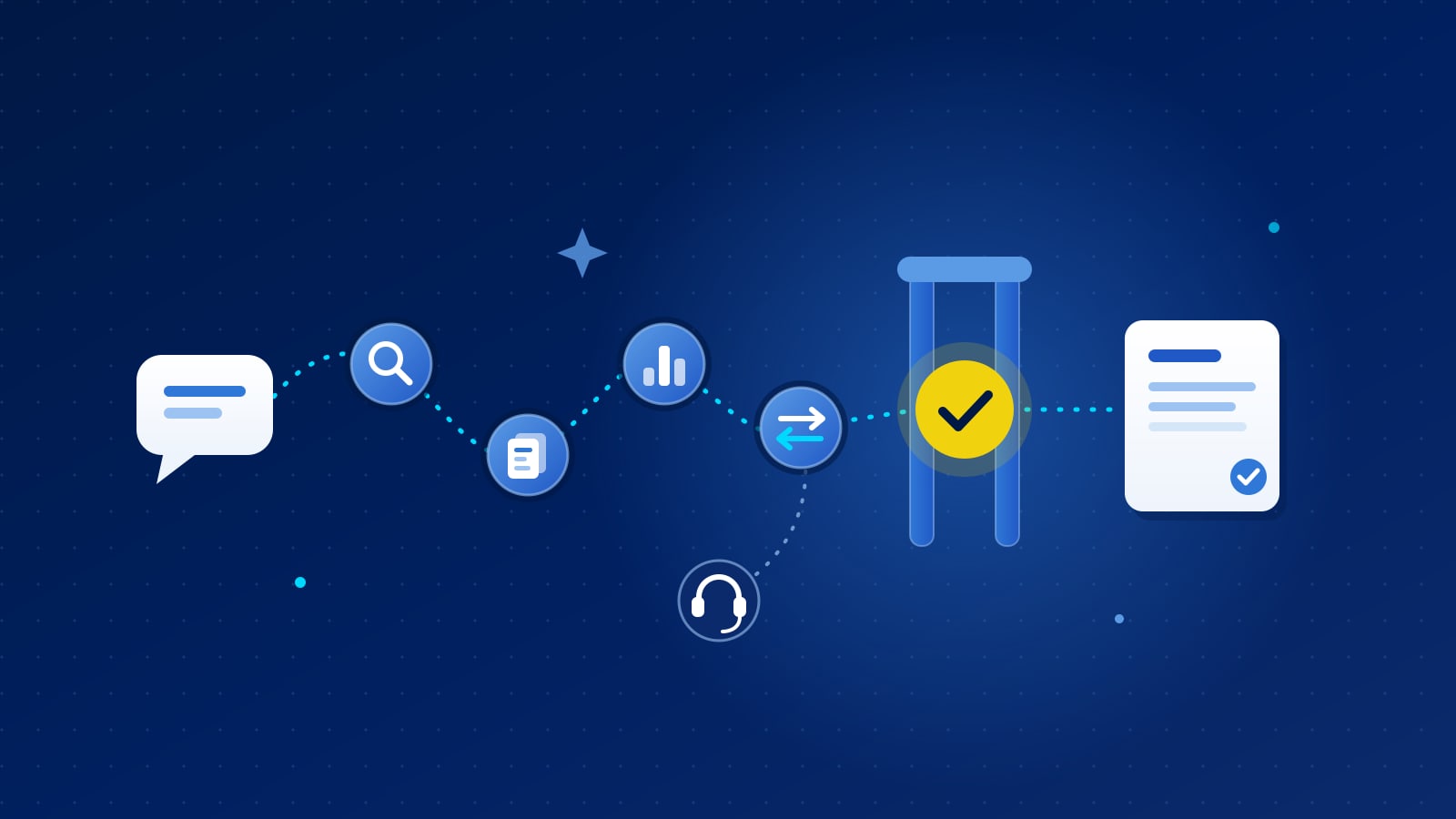
Autonomous procurement means AI agents carry out the routine work of a purchase on their own: reading the request, finding suppliers, running the RFQ, scoring bids and negotiating inside set limits. What an agent should not decide is the frame around that work. People set the rules, approve commitments through their own delegation of authority, and handle the exceptions. The agent does the work; your organisation keeps the authority.
What does autonomous procurement actually mean?
The phrase gets used loosely, so it helps to be precise. An autonomous procurement system is not a tool that suggests suppliers for a buyer to chase. It is software that completes steps of the purchase without a person driving each one, and hands back a result that is ready for a decision.
That distinction matters because it changes where the effort goes. In a manual process, a buyer spends most of the time on mechanics: clarifying the request, finding suppliers, chasing quotes, putting them side by side. In an autonomous one, the mechanics run by themselves and people spend their time on the parts that need judgement and accountability.
It is not the same as removing people from procurement. It is moving them to the points where a human decision is worth something.
Which steps can an AI agent run on its own?
The steps that suit automation share three traits: they repeat, they follow rules you can write down, and a mistake is caught before money is committed. Most of the work in a tail spend purchase fits that description.
- Intake. A requester describes the need in plain English, by chat, voice, email or a document. The agent turns it into a structured request and asks for what is missing, instead of bouncing a form back.
- Matching. The agent checks whether the item is already covered by a catalogue or an existing supplier, and routes it there if so. Only genuinely new needs go to sourcing.
- Supplier search and RFQ. For one-off needs, the agent finds suitable verified suppliers and issues the same request to each of them, with the same specification and deadline.
- Scoring. Bids are scored on price, delivery, terms and supplier risk, against criteria and weights agreed in advance. We cover how to set those in our guide to comparing supplier quotes fairly.
- Negotiation. Inside limits the client sets, the agent negotiates with suppliers on price, terms and lead time, round by round, and records each exchange.
None of these steps commits the business to anything. Each produces information, and each leaves a record. That is what makes them safe to hand over.
What should an AI agent never decide?
Three things stay with people, and a well designed system makes that structural rather than optional.
The rules. Which categories go through the platform, which suppliers are eligible, what the value ceiling per order is, how bids are weighted and where the negotiation limits sit. These are policy choices. An agent should apply them consistently, not set them or quietly adjust them.
The commitment. Approving a purchase order commits your organisation's money, so it belongs to someone with the authority to do that. The cleanest way to keep it there is to route every result through your existing delegation of authority: the same approvers and the same thresholds you already use. Above a given value, more senior sign off; for certain categories, a specialist review. The agent recommends, your approval chain decides.
The exceptions. Some purchases do not fit the pattern: an unusual specification, a single possible supplier, a safety critical part, a request that looks like it should be under a contract. These need a person who can ask questions, weigh trade offs that are not in the rules and take responsibility for the outcome. A good system spots these and hands them over, rather than forcing them through.
Why route approval through your own delegation of authority?
It can be tempting to give an automated platform its own approval logic. That creates a second set of rules that drifts away from the first, and an audit question nobody wants to answer: who actually authorised this spend?
Using the client's own delegation of authority avoids that. Approvers see a complete recommendation, with the suppliers asked, the bids received, the scores and the negotiation history, and approve it in the chain they already work in. Finance sees the same thresholds applied to automated and manual purchases alike. Nothing about who can commit what changes.
It also makes adoption easier. Approvers are not being asked to trust a new decision maker. They are being asked to decide faster, with better information in front of them.
How do you set the boundaries in practice?
The boundaries are where most of the real work sits before switching anything on. A short list covers it:
- Scope. Agree which categories and which value range the agents will handle, and which stay with your category managers. The tail is the natural starting point; our guide to tail spend management explains why.
- Negotiation limits. Set what the agent may concede and what it must not, such as payment terms or warranty below a minimum.
- Escalation triggers. Write down what sends a request to a person: no valid bids, a single supplier, a specification the agent cannot resolve, a category flagged as sensitive.
- Approval mapping. Map value bands and categories to your existing approvers, so every recommendation lands with the right person automatically.
- Audit trail. Make sure every step, from the request to the purchase order, is recorded and kept with the spend.
Review the boundaries after the first weeks of live use. If people override the agent's recommendations often in one category, the rules for that category need changing, not the approvers.
Where METIS fits
METIS is built around this division of work. A requester describes the need in plain English; AI agents find suppliers, issue the RFQ, score bids on price, delivery, terms and supplier risk, and negotiate Agent-to-Agent inside limits the client sets. The result goes through the client's own approval chain, and the purchase order is issued with an audit trail. Alongside the catalogue for recurring items and the AI sourcing agents for one-off needs, a Buying Desk handles the exceptions, so unusual cases reach a person rather than a workaround. You can see the full flow on how it works.
Practical next steps
- List the steps in your current tail spend process and mark each one as mechanics or judgement.
- Write down the rules that already exist informally: value ceilings, eligible suppliers, scoring weights.
- Map your delegation of authority to value bands and categories, ready to plug into any platform.
- Define escalation triggers before anything goes live, with a named owner for exceptions.
- Start narrow with one or two categories, review the overrides, then widen the scope.
Autonomy works when the boundaries are clear. Get those right, and the agents can take on the volume while your team keeps the decisions that matter.