
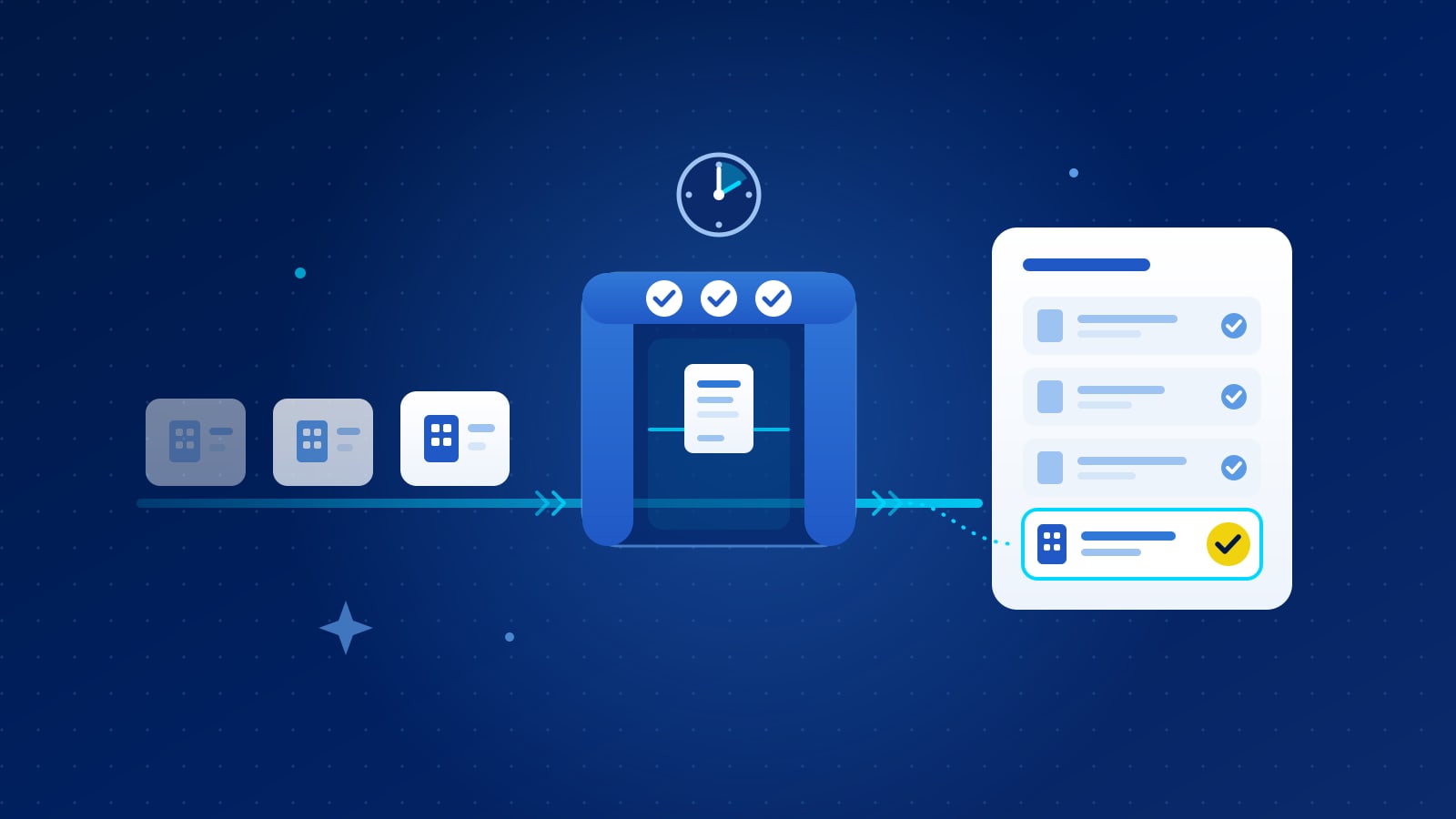
Supplier onboarding time drops from weeks to days when you stop treating every new supplier as a fresh project. Three changes do most of the work: a short, standard set of vendor checks sized to the risk of the purchase, a network of suppliers who have already passed those checks, and, for small one-off buys, a single vendor of record so the supplier never needs to be set up in your own system at all.
Why does supplier onboarding take so long?
Rarely because any single check is hard. The time goes in the gaps between steps.
- Forms go back and forth. The supplier receives a long registration pack, fills in part of it, and the missing items are discovered a few days later.
- Several teams touch it in turn. Procurement, finance, compliance and sometimes IT each review their own section, one after the other, often from a shared inbox.
- The same depth of checks applies to everything. A supplier for a one-off box of spare parts goes through the same review as a strategic partner on a multi-year contract.
- Nobody owns the clock. There is rarely a target for onboarding time, so a stalled request has no one chasing it.
Meanwhile the purchase that triggered the request waits. That is where the hidden cost sits: requesters learn that a new supplier means a long delay, so they go back to a familiar vendor at a worse price, or buy around the process altogether.
Which vendor checks actually matter for a small purchase?
The checks should match the risk, not the paperwork habit. For low-value, one-off tail spend purchases, a sensible baseline is short:
- A valid trade licence, so you know the business exists and is allowed to trade in that activity.
- Tax registration, checked against the documents the supplier provides.
- Bank details, verified before the first payment, never changed by email alone.
- Ownership and sanctions screening, run as a standard step rather than a special request.
- Category-specific items only where the category needs them, such as insurance certificates for on-site services.
Everything beyond that baseline should be triggered by something specific: a higher value, a regulated category, on-site work or a long contract. Writing this down as a tiered rule is the single most useful thing most procurement teams can do for onboarding speed, because it ends the debate on every request.
How does a pre-vetted supplier network change the timeline?
The fastest onboarding is the one that has already happened. If the supplier who wins a quote has passed the same baseline checks before, all that remains is to confirm the documents are still current and to link the supplier to your organisation.
That is the idea behind a pre-vetted network. Instead of starting from a blank form each time, buyers source first from suppliers whose trade licence, registration and bank details are already on file and kept up to date. Onboarding becomes a confirmation step, not an investigation.
It also improves the sourcing itself. When adding a new supplier is cheap, buyers are willing to invite a wider field to quote, which is where better prices and lead times come from.
What is a vendor of record, and when does it help?
For many tail spend purchases, the cleanest answer is not to onboard the supplier into your own system at all.
Under a vendor of record model, one service provider is the supplier your business pays. It buys from the underlying supplier on your behalf, runs the vendor checks on its side, and invoices you as a single vendor. Your finance team keeps one supplier record, one set of bank details and one invoice format, however many different suppliers sit behind it.
This works well for one-off and irregular purchases, where creating a permanent supplier record for a single order is more effort than the order is worth. It suits recurring, high-value relationships less well; those are worth onboarding directly and managing as relationships.
What is a realistic target for supplier onboarding time?
Set a written service level, measured in working days, and report against it. Without a target, onboarding time is invisible until someone complains.
As a reference point, in one Gulf programme we run, supplier onboarding works to a 2 working day SLA. That is the level agreed for that programme, with its own categories and locations, not a promise for every client. Your own level should reflect your risk rules, the categories you buy and how much of the work can start from suppliers that are already vetted.
Whatever target you choose, measure it from the moment a supplier is selected to the moment a purchase order can be issued to them. That is the delay the requester feels.
How does METIS handle supplier onboarding?
METIS is our AI-native tail spend platform. A requester describes the need in plain English, and AI agents find suppliers, issue the request for quote and score bids on price, delivery, terms and supplier risk. They draw on a network of more than 17,000 verified suppliers, so many winning bids come from suppliers that have already been checked.
Through the managed service, we can also invoice the client as a single vendor, which removes the need to set up each new supplier in the client's own system. Every purchase still goes through the client's own approval chain, and the purchase order is issued with an audit trail. Where an exception needs a person, the Buying Desk handles it. For how this fits a wider approach to small purchases, see our guide to tail spend management.
Practical next steps
- Measure today's onboarding time. Take a sample of recently added suppliers and record the working days from selection to first purchase order.
- Write a tiered checks rule. Agree the baseline checks for low-value, one-off purchases and the triggers that add more.
- Run the reviews in parallel. Let finance and compliance review at the same time, from one complete submission, instead of passing the file along.
- Source from vetted suppliers first. Make the already-checked supplier the default option, and onboard a new one when there is a clear reason.
- Decide where a vendor of record fits. Identify the one-off and irregular categories where a single vendor would save your finance team the most set-up work.
- Put the target in writing. Agree an onboarding SLA in working days and report against it every month.
If one-off purchases are also slowed by the quoting stage, our article on what a buying desk does covers the rest of the route from request to purchase order.